

Advantages and Disadvantages Comparison of Negative Pressure and Positive Pressure Conveying for Gyp
Gypsum sand, a vital raw material in industries such as construction, cement production, and chemical processing, often requires efficient transportation. Air-flow conveying, which utilizes air to move bulk materials, addresses the challenges of transporting gypsum sand over long distances or in complex layouts. Two primary approaches dominate this field: negative pressure (suction) conveying and positive pressure (blowing) conveying. Understanding the advantages and disadvantages of each method is essential for selecting the most suitable system for specific operational needs.


Advantages and Disadvantages of Negative Pressure Conveying for Gypsum Sand
Negative pressure conveying, also known as suction conveying, operates by creating a low-pressure zone at the material intake point, drawing gypsum sand into the pipeline using a vacuum pump. This method offers several benefits that make it attractive for certain applications. One key advantage is the ability to convey materials from multiple sources or over long distances without needing multiple blowing stations. The system effectively handles dusty or fine particles, as the vacuum maintains a consistent flow and minimizes material loss. Additionally, negative pressure conveying is more energy-efficient compared to positive pressure systems, as it requires less power to maintain the vacuum state. However, this method has notable drawbacks. The primary limitation is the shorter maximum conveying distance compared to positive pressure systems, due to pressure drop and the need to maintain sufficient vacuum throughout the pipeline. Another disadvantage is the risk of air leakage or contamination, as the system relies on tight seals to prevent external air from entering and affecting material quality. Furthermore, negative pressure conveying may not be suitable for materials with high moisture content or those prone to caking, as the vacuum can cause material clumping and blockages.
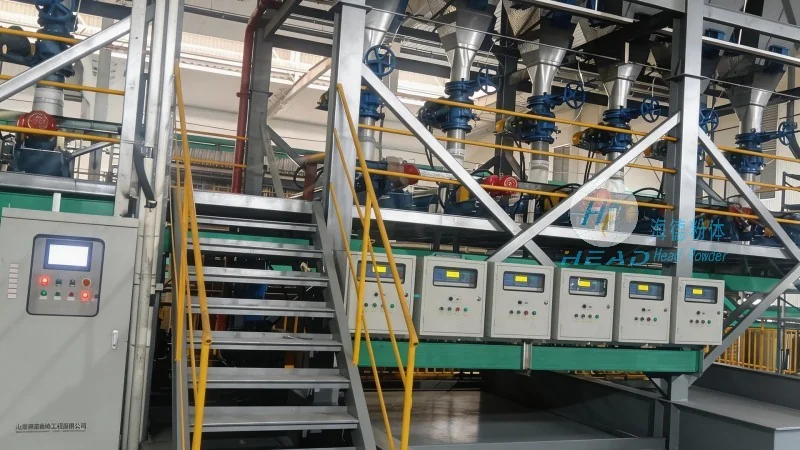
Advantages and Disadvantages of Positive Pressure Conveying for Gypsum Sand
Positive pressure conveying, or blowing conveying, works by using a blower or compressor to generate high-pressure air that pushes gypsum sand through the pipeline. This method is effective for longer distances and can handle a wider range of materials, including those with higher moisture content or larger particle sizes. One main advantage is the ability to transport materials over extended distances, often exceeding negative pressure limits. The high-pressure air ensures a consistent flow rate and prevents material settling or blockages, making it suitable for reliable, continuous transport. Additionally, positive pressure conveying is less susceptible to external air contamination, as the system operates under positive pressure, reducing dust or moisture ingress. However, this method has significant drawbacks. The most prominent is higher energy consumption compared to negative pressure systems, as the blower must generate sufficient pressure, leading to increased operational costs. Another limitation is potential material degradation or wear on pipeline components, as high-pressure air causes abrasion and erosion, especially with abrasive materials like gypsum sand. Furthermore, positive pressure conveying may not be ideal for critical dust control applications, as the system generates more dust during operation, requiring additional filtration or containment measures.

Key Considerations for Selecting the Right Conveying Method
When choosing between negative pressure and positive pressure conveying for gypsum sand, several factors must be considered for optimal performance and cost-effectiveness. The first consideration is conveying distance and layout. For shorter distances or multiple intake points, negative pressure conveying may be more suitable due to energy efficiency and multi-source handling. Conversely, for longer distances or single continuous lines, positive pressure conveying is often better. The second factor is material characteristics, including particle size, moisture content, and abrasiveness. Fine or dusty materials may benefit from negative pressure systems, as the vacuum maintains flow, while larger or more abrasive materials require positive pressure systems' higher pressure and durability. The third consideration is environmental and safety requirements. Negative pressure systems are better for dust control, minimizing airborne particle release. Positive pressure systems, while less susceptible to contamination, may need additional filtration for regulations. Finally, operational cost and maintenance should be evaluated. Negative pressure systems typically have lower energy costs and simpler maintenance, while positive pressure systems may require more frequent component replacement due to wear.