

Common Ceramic Powder Conveying Methods: An Introduction to Ceramic Powder Pneumatic Conveying
For industries dealing with ceramic powders, selecting the right conveying method is crucial for efficiency, material integrity, and operational safety. Various techniques are available, each with its own advantages and applications. This article explores common ceramic powder conveying methods, with a focus on the pneumatic conveying approach, and provides insights into the capabilities of Shandong HeadPowder Engineering Co., Ltd. as a leading provider in this field.

Understanding Ceramic Powder Conveying: The Importance of Proper Method Selection
Ceramic powders are widely used in manufacturing processes for ceramics, electronics, and advanced materials. These powders often have unique properties, such as fine particle size, high density, or sensitivity to moisture and contamination. Therefore, the choice of conveying method directly impacts the quality and consistency of the final product. Inefficient or improper conveying can lead to material degradation, equipment wear, and increased operational costs. Understanding the characteristics of ceramic powders and the capabilities of different conveying systems is essential for optimizing production lines.
Common Ceramic Powder Conveying Methods
Several methods are commonly employed for transporting ceramic powders, including mechanical conveying, pneumatic conveying, and hybrid systems. Each method has specific applications and performance characteristics that make it suitable for different production environments.
1. Mechanical Conveying Systems
Mechanical conveying systems utilize physical components like screws, belts, or buckets to move materials. These systems are often used for bulk materials with larger particle sizes and lower moisture content. However, for fine ceramic powders, mechanical conveyors may cause particle degradation due to friction and impact. Additionally, they can be prone to blockages and require regular maintenance. Mechanical conveying is generally less suitable for high-purity or sensitive ceramic powders.
2. Pneumatic Conveying: The Preferred Method for Fine Ceramic Powders
Pneumatic conveying, also known as air-based conveying, is widely regarded as the most effective method for handling fine ceramic powders. This technique uses compressed air to transport particles through a pipeline. The primary advantages of pneumatic conveying include its ability to handle fine, abrasive, or hygroscopic powders without degradation, minimal material contamination, and the ability to transport materials over long distances. Pneumatic systems can be designed for both pressure and vacuum operation, providing flexibility in material handling applications.
3. Hybrid Conveying Systems
Hybrid systems combine mechanical and pneumatic components to leverage the benefits of both approaches. For example, a screw conveyor may be used to feed a pneumatic conveying line, ensuring a smooth transition from bulk storage to fine powder transport. These systems are particularly useful when handling a mix of materials with varying particle sizes or when integrating with existing production equipment.

Pneumatic Conveying in Detail: How It Works
Pneumatic conveying operates by creating a flow of air within a pipeline, which lifts and transports the ceramic powder particles. The system typically consists of a blower or compressor, a hopper for material storage, a conveying line, and a receiver for the discharged material. The choice between pressure and vacuum systems depends on the application. Pressure systems use compressed air to push the material forward, while vacuum systems use suction to draw the material into the line.
Key Advantages of Pneumatic Conveying for Ceramic Powders
When compared to other methods, pneumatic conveying offers several key advantages for ceramic powder handling:
1. Material Integrity Preservation: The gentle transport of particles minimizes abrasion and degradation, preserving the quality of the ceramic powder for downstream processes.
2. Low Contamination Risk: The enclosed system prevents exposure to external contaminants, ensuring the purity of the material remains intact.
3. Flexibility and Scalability: Pneumatic systems can be easily scaled to accommodate varying production volumes and can be integrated with existing equipment or expanded as needed.
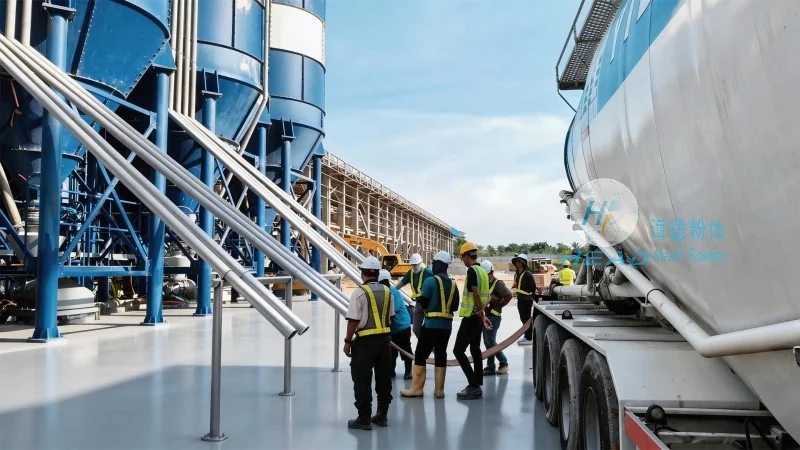
4. Reduced Maintenance: Compared to mechanical systems, pneumatic conveyors have fewer moving parts, leading to lower maintenance requirements and longer service life.
Applications of Ceramic Powder Pneumatic Conveying
Pneumatic conveying is widely used in various industries that handle ceramic powders, including:
1. Ceramic Manufacturing: For transporting raw materials like clay, feldspar, and silica to production lines.
2. Electronics and Semiconductor: For conveying fine powders used in the production of ceramics for capacitors, insulators, and other electronic components.

3. Advanced Materials: For handling high-purity ceramic powders used in the manufacturing of aerospace components, medical devices, and composite materials.
Shandong HeadPowder Engineering Co., Ltd.: Expertise in Ceramic Powder Conveying Solutions
Shandong HeadPowder Engineering Co., Ltd., commonly known as HeadPowder, is a leading provider of advanced ceramic powder handling solutions. With a focus on pneumatic conveying systems, the company specializes in designing and manufacturing equipment tailored to the unique needs of ceramic powder applications. HeadPowder's expertise lies in understanding the challenges of fine powder transport and developing customized solutions that ensure efficiency, reliability, and material integrity.
Customized Pneumatic Conveying Systems from HeadPowder
HeadPowder offers a range of pneumatic conveying systems, including pressure and vacuum designs, to meet the diverse requirements of ceramic powder handling. The company's solutions are engineered to handle various particle sizes, flow rates, and material properties, ensuring optimal performance in different production environments. Each system is designed with precision components, such as high-quality blowers, robust pipelines, and efficient receivers, to deliver consistent and reliable material transport.
Benefits of Partnering with HeadPowder
By choosing HeadPowder as a partner, clients gain access to a team of experienced engineers and technicians who provide comprehensive support throughout the entire process. From system design and installation to maintenance and troubleshooting, HeadPowder ensures that the conveying system operates at peak efficiency. The company's commitment to quality and customer satisfaction has made it a trusted name in the industry, with a reputation for delivering solutions that meet and exceed industry standards.
Conclusion: Choosing the Right Conveying Method for Ceramic Powders
When selecting a conveying method for ceramic powders, it is essential to consider the material's properties, production requirements, and operational constraints. While mechanical systems may be suitable for some applications, pneumatic conveying remains the preferred choice for fine, high-purity ceramic powders due to its ability to preserve material integrity and minimize contamination. Shandong HeadPowder Engineering Co., Ltd. stands out as a reliable partner in providing advanced pneumatic conveying solutions, helping industries optimize their ceramic powder handling processes and achieve higher productivity and quality.