

Advantages and Disadvantages of Negative Pressure vs. Positive Pressure Conveying in Light Calcium C
HeadPowder, a leading provider of pneumatic conveying solutions, specializes in the efficient transport of light calcium carbonate. In industrial applications, the choice between negative pressure (suction) and positive pressure (blowing) conveying systems is critical for optimizing performance, cost, and operational safety. This article provides a detailed comparison of the advantages and disadvantages of negative pressure versus positive pressure conveying in light calcium carbonate transport.

Introduction to Pneumatic Conveying Systems
Pneumatic conveying is a widely used method for transporting bulk materials like light calcium carbonate, which is commonly utilized in industries such as paper, plastics, and construction. The two primary types of pneumatic conveying systems are negative pressure (or suction) conveying and positive pressure (or blowing) conveying. Each system operates on different principles, offering distinct advantages and challenges that influence their suitability for specific applications.
Negative Pressure (Suction) Conveying: Principle and Operation
Negative pressure conveying, also known as suction conveying, operates by creating a low-pressure zone at the material intake point. This is typically achieved using a vacuum pump or fan that draws air and material particles into the system. The material is then transported through a pipeline to a discharge point where the pressure is higher, causing the material to be discharged under gravity or with the help of a rotary valve.
Advantages of Negative Pressure Conveying for Light Calcium Carbonate
One of the key advantages of negative pressure conveying is its ability to minimize material loss and contamination. Since the system operates by drawing material into the pipeline, there is less risk of spillage or dust leakage compared to positive pressure systems. This makes it ideal for transporting light calcium carbonate, which is often used in applications where product purity is paramount, such as in the production of high-quality paper or plastic additives.
Another advantage is the reduced risk of dust explosion. Negative pressure systems are inherently safer as they do not generate high-pressure air that could potentially ignite dust clouds. This is particularly important in facilities handling combustible materials like light calcium carbonate, which can pose significant fire and explosion hazards.
Additionally, negative pressure conveying is well-suited for long-distance or complex routing requirements. The vacuum created at the intake can maintain a consistent flow over longer distances and through multiple bends or changes in elevation, making it a flexible solution for challenging layouts. This flexibility is crucial for industrial plants where material must be transported from multiple sources to a central processing unit.
Disadvantages of Negative Pressure Conveying
Despite its advantages, negative pressure conveying has several drawbacks. The primary challenge is the higher energy consumption compared to positive pressure systems. Vacuum pumps require more power to maintain the low-pressure environment, which can increase operational costs over time. This higher energy demand may not be feasible for facilities with limited power capacity or those operating on a tight budget.
Another disadvantage is the potential for system inefficiency due to air leakage. If the pipeline or seals are not properly maintained, air can leak into the system, reducing the vacuum level and causing the material flow to become unstable or even stop. This requires regular maintenance and monitoring to ensure optimal performance.
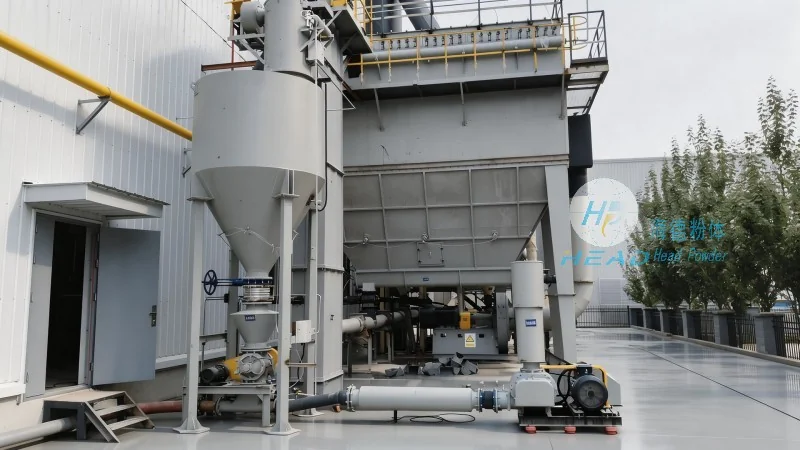
Furthermore, negative pressure conveying may not be suitable for high-volume or high-concentration material transport. The suction capacity of the system is limited by the vacuum pump's capability, and transporting large quantities of light calcium carbonate can strain the system, leading to reduced throughput or increased wear on components.
Positive Pressure (Blowing) Conveying: Principle and Operation
Positive pressure conveying, or blowing conveying, operates by forcing air and material particles through a pipeline using a positive pressure fan or blower. The material is introduced at the intake point and is then carried by the high-pressure air to the discharge point. The air is typically filtered and recycled to minimize dust emissions and maintain system efficiency.
Advantages of Positive Pressure Conveying for Light Calcium Carbonate
One of the main advantages of positive pressure conveying is its higher material transport capacity. The high-pressure air can move larger volumes of light calcium carbonate at a faster rate, making it suitable for high-throughput applications such as large-scale production lines. This increased capacity reduces the number of required transfer points and simplifies the overall system layout.
Another advantage is the simplicity of the system design. Positive pressure conveying typically requires fewer components compared to negative pressure systems, as there is no need for a vacuum pump or complex sealing mechanisms. This simplification can lead to lower initial installation costs and easier maintenance, as fewer parts are involved in the operation.
Additionally, positive pressure systems are generally more reliable for short-distance or high-concentration material transport. The high-pressure air can maintain a consistent flow over shorter distances and through fewer bends, making it efficient for applications where the material is transported from a central storage to a processing unit within a facility.
Disadvantages of Positive Pressure Conveying
Despite its advantages, positive pressure conveying has significant drawbacks, particularly in terms of safety and environmental impact. The high-pressure air used in the system can generate dust clouds that pose a fire and explosion risk, especially when handling combustible materials like light calcium carbonate. This requires stringent safety measures, such as explosion-proof equipment and proper dust collection systems, which can increase operational costs and complexity.

Another disadvantage is the higher risk of material degradation. The high-velocity air in positive pressure systems can cause abrasion and wear on the material particles, potentially reducing their quality or affecting downstream processes. For light calcium carbonate, which is often used in applications requiring specific particle size or purity, this wear can be detrimental to product performance.
Furthermore, positive pressure conveying may not be suitable for long-distance or complex routing. The high-pressure air can lose efficiency over longer distances and through multiple bends, leading to reduced material flow and increased energy consumption. This limits its use to shorter transport distances and simpler layouts, making it less flexible compared to negative pressure systems.
Comparison: Negative Pressure vs. Positive Pressure Conveying
When comparing negative and positive pressure conveying for light calcium carbonate, several factors must be considered to determine the most suitable system. The choice depends on the specific application requirements, including material volume, distance, complexity of the route, and safety considerations.
For applications requiring high purity and minimal contamination, negative pressure conveying is often the preferred option. Its ability to maintain product integrity and reduce dust emissions makes it ideal for industries where quality control is critical. However, the higher energy costs and potential for system inefficiency may make it less economical for large-scale operations.
On the other hand, positive pressure conveying is better suited for high-volume, short-distance transport where cost efficiency and system simplicity are prioritized. Its higher capacity and lower initial costs make it a viable choice for facilities with limited space or budget constraints. However, the safety risks and potential for material degradation must be carefully managed to ensure operational safety and product quality.
Conclusion
Both negative pressure and positive pressure conveying systems offer viable solutions for the transport of light calcium carbonate, each with its own set of advantages and disadvantages. The optimal choice depends on the specific needs of the application, including material characteristics, transport distance, and operational constraints. By understanding the principles and trade-offs of each system, industrial facilities can select the most appropriate conveying method to optimize performance, cost, and safety.
HeadPowder, with its expertise in pneumatic conveying technology, provides tailored solutions to meet the diverse needs of light calcium carbonate transport. Our team of engineers works closely with clients to assess their specific requirements and recommend the most efficient and cost-effective conveying system. Whether negative or positive pressure is chosen, HeadPowder ensures that the transport process is optimized for maximum productivity and minimal environmental impact.