

Operation Process and Working Principle of Quicklime Pneumatic Conveying Equipment
Quicklime, also known as calcium oxide, is a critical industrial material widely used in construction, chemical manufacturing, and environmental treatment. The efficient and safe transportation of quicklime from production sites to processing facilities is essential for maintaining production efficiency and ensuring product quality. This article provides a detailed overview of the operation process and working principle of quicklime pneumatic conveying equipment, highlighting the key components, operational steps, and technical mechanisms that enable reliable material handling.

Introduction to Quicklime Pneumatic Conveying Equipment
Shandong HeadPowder Engineering Co., Ltd., a leading manufacturer in the field of powder handling systems, specializes in designing and supplying advanced pneumatic conveying solutions tailored to the unique requirements of quicklime handling. The equipment developed by HeadPowder combines robust engineering with innovative technology to address the challenges associated with transporting quicklime, such as its high reactivity, dust generation, and potential for caking. By leveraging pneumatic conveying technology, the system ensures minimal product degradation, reduced downtime, and enhanced operational safety.
Key Components of the Pneumatic Conveying System
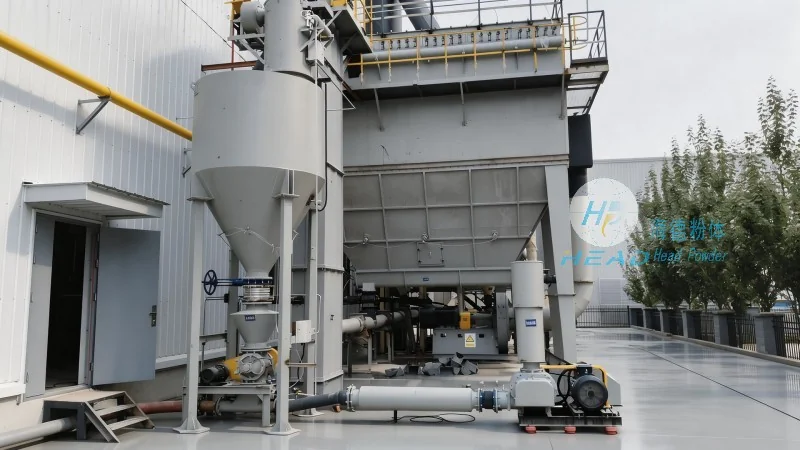
The quicklime pneumatic conveying system consists of several critical components that work in tandem to achieve efficient material transport. These components include a hopper for material storage, a rotary valve or feeder to control the flow rate, a conveying pipeline, a blower or compressor to generate the necessary air pressure, and a dust collection system to ensure environmental compliance. Each component is carefully selected and engineered to withstand the corrosive and abrasive nature of quicklime, ensuring long-term reliability and minimal maintenance.

Operation Process: Step-by-Step Guide
The operation of the quicklime pneumatic conveying equipment follows a systematic process that ensures consistent and reliable material transport. The process begins with the loading of quicklime into the hopper. The rotary valve then regulates the flow of material into the conveying pipeline, controlling the feed rate to match the system's capacity. Simultaneously, the blower generates a high-pressure air stream that propels the quicklime particles through the pipeline. The air and material mixture travels to the destination point, where a separator or cyclone separates the material from the air. The separated quicklime is then discharged into the receiving container, while the air is filtered and discharged safely. This cycle repeats continuously, maintaining a steady flow of quicklime from the source to the processing unit.

Working Principle: The Science Behind Pneumatic Conveying
The working principle of the quicklime pneumatic conveying system is based on the fundamental concept of fluidization and suspension of solid particles in a gas stream. When the air is introduced into the conveying pipeline at a sufficient velocity, it creates a turbulent flow that lifts the quicklime particles and suspends them in the air stream. This suspension allows the particles to be transported over long distances without the need for mechanical components like belts or buckets. The key to efficient conveying lies in maintaining the correct air velocity and pressure, which depends on factors such as the particle size, density, and moisture content of the quicklime. HeadPowder's systems are equipped with advanced control systems that adjust the air pressure and flow rate in real-time, optimizing the conveying process and minimizing energy consumption.
Advantages of Quicklime Pneumatic Conveying Equipment
Compared to traditional mechanical conveying methods, quicklime pneumatic conveying offers several significant advantages. Firstly, it eliminates the need for moving parts in the conveying line, reducing the risk of mechanical failure and minimizing maintenance requirements. Secondly, the system provides a dust-free and enclosed environment, preventing product contamination and protecting operators from exposure to dust. Thirdly, the high conveying velocity allows for longer transport distances and higher throughput, improving overall production efficiency. Additionally, the system's flexibility allows for easy integration with existing production lines and can be scaled to accommodate varying production volumes.
Application Scenarios and Industry Impact
The quicklime pneumatic conveying equipment developed by Shandong HeadPowder Engineering Co., Ltd. is widely used in various industrial applications where quicklime is a critical component. In the construction industry, the equipment is used to transport quicklime to cement production facilities, where it is used as a raw material for cement manufacturing. In the chemical industry, the system is employed to move quicklime to chemical processing plants for use in the production of calcium-based chemicals. In environmental applications, the equipment is utilized to transport quicklime for flue gas desulfurization and other pollution control processes. By providing a reliable and efficient means of quicklime transportation, HeadPowder's systems contribute to improved production efficiency, reduced operational costs, and enhanced environmental compliance across various industries.