

Operation Process and Working Principle of Battery Material Powder Conveying System Equipment
HeadPowder, a leading manufacturer in the field of powder handling technology, specializes in the design, development, and production of advanced equipment for the battery material industry. The company's core product, the battery material powder conveying system, is engineered to meet the stringent demands of modern battery production lines, ensuring efficient, reliable, and safe material transport. This article provides a detailed overview of the operational process and working principles of such systems, highlighting their importance in optimizing battery manufacturing workflows.
Company Profile and Expertise
HeadPowder, operating under the full name Shandong HeadPowder Engineering Co., Ltd., is headquartered in Shandong, China. With years of experience in powder processing and conveying systems, the company has established itself as a trusted partner for businesses in the battery and related industries. The company's team of engineers and technicians brings deep expertise in material science, mechanical engineering, and automation, enabling the development of customized solutions that address specific customer needs. By focusing on innovation and quality, HeadPowder ensures that its products not only meet but exceed industry standards, contributing to the efficiency and sustainability of battery production processes.

Understanding the Battery Material Powder Conveying System
The battery material powder conveying system is a critical component in the battery manufacturing process, responsible for transporting various powders such as cathode active materials, anode materials, and binders from storage to processing units. These systems are designed to handle materials with different properties, including varying particle sizes, moisture content, and flow characteristics. The equipment must maintain material integrity, prevent contamination, and ensure consistent flow rates to support downstream processes like mixing, coating, and forming. The system's design integrates multiple technologies, including pneumatic conveying, mechanical conveying, and automated control systems, to achieve optimal performance.

Key Components and Their Functions
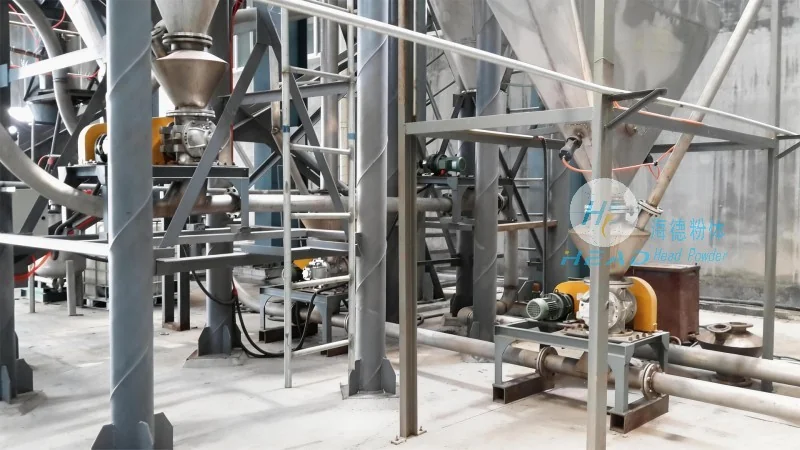
The battery material powder conveying system typically consists of several key components, each playing a vital role in the overall operation. These include: (1) Hoppers and feeders, which store and feed the powder into the conveying line; (2) Conveying lines, which transport the material through pipelines using air or mechanical force; (3) Filters and dust collectors, which ensure air quality and prevent material loss; (4) Control systems, which monitor and regulate the flow of material and air. Each component is carefully selected and integrated to work in harmony, ensuring smooth and continuous operation. For example, the hoppers are designed with appropriate dimensions and discharge mechanisms to prevent material bridging and ensure uniform feeding. The conveying lines are made of materials resistant to corrosion and wear, suitable for handling abrasive battery materials. The filters and dust collectors are equipped with advanced filtration technologies to capture fine particles and maintain a clean working environment.
Operation Process: From Material Loading to Discharge
The operation of the battery material powder conveying system follows a systematic process, starting with material loading and ending with discharge at the processing unit. The process can be broken down into the following steps: (1) Material Loading: Powders are loaded into the hoppers from bulk containers or storage silos. The hoppers are equipped with level sensors to monitor the material level and trigger feeding when necessary. (2) Feeding: The feeder, often a rotary valve or a screw feeder, regulates the flow rate of the powder into the conveying line. The feeder's speed is controlled based on the required flow rate and the material's characteristics. (3) Conveying: The powder is transported through the conveying line using air or mechanical force. In pneumatic conveying systems, compressed air is used to create a pressure differential that moves the material. In mechanical conveying systems, such as belt or screw conveyors, the material is moved by mechanical means. (4) Filtration and Cleaning: The air carrying the powder passes through filters and dust collectors, which remove fine particles and return clean air to the system or the environment. (5) Discharge: The powder is discharged from the conveying line into the processing unit, such as a mixer or a coating machine. The discharge point is equipped with a valve or a hopper to control the flow and prevent material spillage. Each step is monitored by the control system, which adjusts parameters as needed to maintain optimal performance. The entire process is designed to be continuous and efficient, minimizing downtime and maximizing material throughput.

Working Principle: How the System Ensures Efficiency and Reliability
The working principle of the battery material powder conveying system is based on the principles of fluid dynamics and material handling. The system operates by creating a flow path for the powder, using either air (pneumatic) or mechanical force (mechanical) to move the material. In pneumatic conveying, the compressed air is introduced into the conveying line, creating a pressure difference between the inlet and outlet. This pressure difference causes the powder to be suspended in the air stream and transported through the pipeline. The air velocity is carefully controlled to ensure that the powder particles are fully entrained and do not settle. In mechanical conveying, the material is moved by rotating components, such as screws or belts, which push the material along the conveying path. The speed and torque of the mechanical components are adjusted to maintain a consistent flow rate. The control system plays a crucial role in regulating the operation of the system. It monitors parameters such as pressure, flow rate, and material level, and adjusts the settings of the feeder, compressor, or motor as needed. This closed-loop control ensures that the system operates within optimal parameters, preventing overloading, underloading, or other issues that could affect performance. Additionally, the system incorporates safety features, such as pressure relief valves and emergency stop buttons, to protect operators and equipment from potential hazards. By integrating these principles and features, the battery material powder conveying system ensures high efficiency, reliability, and safety in the battery manufacturing process.