

Principle and Working Scenario Characteristics of Ash Slag Pneumatic Conveying
As a specialized engineering company, Shandong HeadPowder Engineering Co., Ltd. (hereinafter referred to as HeadPowder) provides comprehensive solutions for ash slag handling and transportation. This article focuses on the fundamental principles of ash slag pneumatic conveying and its typical application scenarios, offering insights into the technology's operational mechanisms and practical implementation.

The Core Principle of Ash Slag Pneumatic Conveying
Ash slag pneumatic conveying is a method that utilizes compressed air or other gas to transport bulk materials like ash and slag from one location to another. The process typically involves a conveying pipeline system where the material is suspended and transported by the airflow. The fundamental principle revolves around creating a sufficient gas velocity to overcome the material's gravity and friction within the pipeline. This is achieved through the use of air movers, such as blowers or fans, which generate the necessary pressure and flow rate. The material is fed into the pipeline, often via a hopper or feeder, and is then entrained by the moving air. The key to efficient conveying lies in maintaining an appropriate gas-to-solid ratio, ensuring that the material remains in a suspended state throughout the pipeline. This technology is particularly effective for handling abrasive and heavy materials, as it minimizes mechanical wear compared to traditional belt or screw conveyors.

Key Working Scenario Characteristics
The application of ash slag pneumatic conveying is characterized by several distinct features that make it suitable for specific industrial environments. Firstly, it offers a flexible and compact system design, allowing for installation in confined spaces or complex layouts. The pipeline can be arranged in various configurations, including vertical, horizontal, or inclined paths, adapting to the site's topography and layout requirements. Secondly, the system provides excellent dust control and environmental protection. By enclosing the material in a sealed pipeline, it prevents dust emissions and ensures compliance with environmental regulations. This is crucial in industrial settings where air quality is a concern. Thirdly, the technology enables remote operation and automation, reducing the need for manual handling and enhancing safety. The conveying process can be integrated with other industrial systems, such as waste treatment or power generation plants, allowing for seamless material flow management.
Practical Application Examples
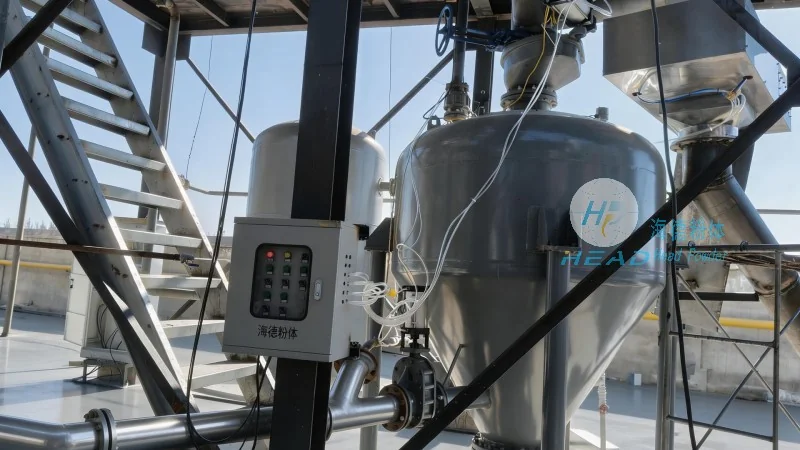
HeadPowder has successfully implemented ash slag pneumatic conveying systems in various industrial settings. For instance, in thermal power plants, the technology is used to transport fly ash and bottom ash from the boiler to storage silos or disposal sites. The system efficiently handles large volumes of ash, with typical capacities ranging from 10 to 200 tons per hour, depending on the plant's scale. Another application is in cement production facilities, where ash slag is used as a raw material for cement production. The pneumatic conveying system ensures a consistent and high-quality feed to the cement kiln, improving the overall production efficiency. Additionally, in industrial waste treatment plants, the technology is employed to transport slag from incineration processes to recycling or disposal facilities. The system's ability to handle abrasive materials makes it ideal for these applications, as it minimizes equipment wear and extends the service life of the conveying components.
Advantages and Considerations
Compared to traditional conveying methods, ash slag pneumatic conveying offers several advantages. The primary benefit is the reduction in operational costs due to lower maintenance requirements and energy efficiency. The sealed system also reduces labor costs associated with manual handling and cleaning. Furthermore, the technology enhances safety by eliminating the need for workers to be in close proximity to the material, reducing the risk of dust exposure and physical injury. However, there are also considerations to keep in mind. The initial investment for a pneumatic conveying system can be higher than for mechanical conveyors, especially for large-scale applications. Additionally, the system requires regular maintenance of the air movers and pipeline components to ensure optimal performance. Proper sizing of the air volume and pressure is critical to avoid system inefficiencies or material blockages. HeadPowder provides comprehensive engineering services to address these considerations, ensuring that the system is designed and installed to meet the specific needs of each project.