

Key Design Considerations for Aluminum Nitride Pneumatic Conveying System Solutions
Aluminum nitride (AlN) is a high-performance ceramic material widely used in semiconductor manufacturing, electronics, and advanced materials industries due to its excellent thermal conductivity, electrical insulation properties, and chemical stability. The efficient and reliable transportation of AlN powder is critical for maintaining product quality and operational efficiency in production lines. Pneumatic conveying systems offer a non-contact, low-maintenance method for handling AlN, but their design requires careful consideration of material characteristics, system performance, and operational safety. This article outlines key design considerations for developing effective AlN pneumatic conveying solutions.

Material Properties and Handling Challenges
AlN powder exhibits unique physical and chemical properties that influence system design. It typically has a fine particle size, often ranging from 1 to 100 microns, with a high specific surface area. This leads to challenges such as agglomeration, dust generation, and abrasive wear on system components. The material is also sensitive to moisture and temperature changes, which can affect its reactivity and performance in downstream processes. Therefore, the design must account for these characteristics to prevent material degradation and ensure consistent product quality. For instance, the choice of material for the conveying line, such as stainless steel or special alloys, is critical to withstand the abrasive nature of AlN particles and resist corrosion from any residual moisture.
System Configuration and Conveying Principles
The core of an AlN pneumatic conveying system involves the selection of appropriate conveying principles, such as dilute-phase or dense-phase transport, based on the material's flowability and the required distance. Dilute-phase systems use low air velocities to transport particles in a dispersed state, suitable for short distances and low particle concentrations. Dense-phase systems, on the other hand, operate at higher air velocities and lower particle concentrations, ensuring more controlled and stable flow, which is essential for handling fine, cohesive powders like AlN. The system configuration also includes components like feeders, cyclones, filters, and control valves, each designed to optimize material handling and minimize losses. The selection of these components must align with the material's properties to prevent blockages, ensure efficient separation of particles from air, and maintain system efficiency.

Design Considerations for Key Components
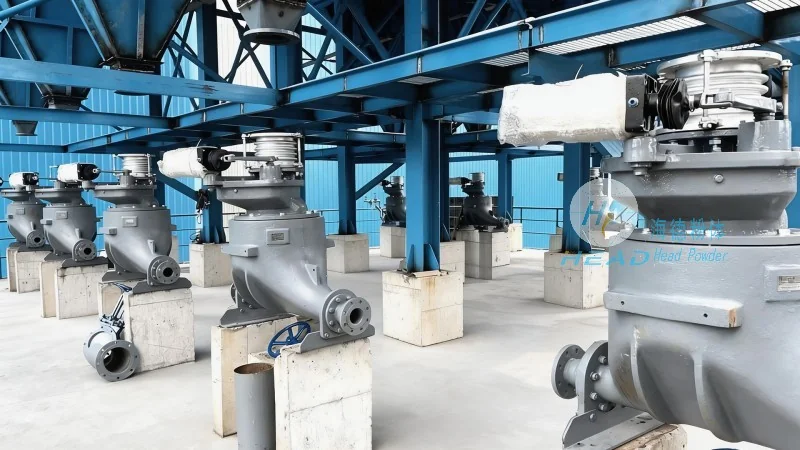
Several critical components in an AlN pneumatic conveying system require specialized design to handle the material's unique characteristics. The material feeders, for example, must provide consistent and controlled feeding rates to avoid surges or underflow, which can lead to system instability. Screw feeders or rotary valves are commonly used, but they need to be equipped with wear-resistant liners and anti-static measures to prevent material buildup and ensure smooth operation. The conveying line itself, including pipes and fittings, must be constructed from materials that can withstand the abrasive nature of AlN particles and resist corrosion. Stainless steel or high-alloy steels are typical choices, with smooth internal surfaces to minimize friction and particle accumulation. Cyclones and filters are essential for separating AlN particles from the air stream, and their design must consider the high dust loading and potential for particle re-entrainment. Efficient filtration systems, such as bag filters or cartridge filters, are necessary to maintain air quality and comply with environmental regulations.
Control and Monitoring Systems
Effective control and monitoring are vital for maintaining the performance and safety of an AlN pneumatic conveying system. Automated control systems, including pressure sensors, flow meters, and level indicators, provide real-time data on system performance and help detect anomalies early. These systems can adjust air pressure, flow rates, and feeding rates dynamically to optimize operation and prevent issues like overloading or under-conveying. Additionally, monitoring for temperature and moisture levels is important, as AlN is sensitive to these factors. The integration of these control systems with the overall production process ensures that the conveying system operates in harmony with downstream operations, minimizing downtime and maximizing productivity. Regular maintenance and calibration of these systems are also essential to ensure long-term reliability.
Safety and Environmental Considerations
Handling AlN powder involves safety and environmental considerations that must be addressed in the system design. AlN is generally considered non-toxic, but fine particles can cause respiratory irritation if inhaled in large quantities. Therefore, the system must include effective dust control measures, such as local exhaust ventilation and dust collection systems, to minimize exposure risks. The design should also consider the potential for fire or explosion, as some AlN powders can be pyrophoric under certain conditions. Proper grounding and explosion-proof components are necessary to mitigate these risks. From an environmental perspective, the system must comply with local regulations regarding air emissions and waste disposal. The use of efficient filtration systems and proper waste management practices ensures that the operation is environmentally sustainable and responsible.
Case Study: Successful Implementation by Shandong HeadPowder Engineering Co., Ltd.
Shandong HeadPowder Engineering Co., Ltd., a leading provider of engineering solutions for powder handling systems, has successfully implemented AlN pneumatic conveying systems for various clients. One notable project involved supplying a high-purity AlN powder to a semiconductor manufacturer, where the system was designed to transport the material from storage silos to a production line over a distance of 50 meters. The system incorporated a dense-phase conveying principle to ensure stable and efficient transport, with stainless steel components to handle the abrasive nature of the powder. The control system provided real-time monitoring of pressure and flow, allowing for immediate adjustments to maintain optimal performance. The project resulted in a significant reduction in material loss and increased production efficiency, demonstrating the effectiveness of the design approach. This case study highlights the importance of considering material properties, system configuration, and control strategies in developing reliable AlN pneumatic conveying solutions.